
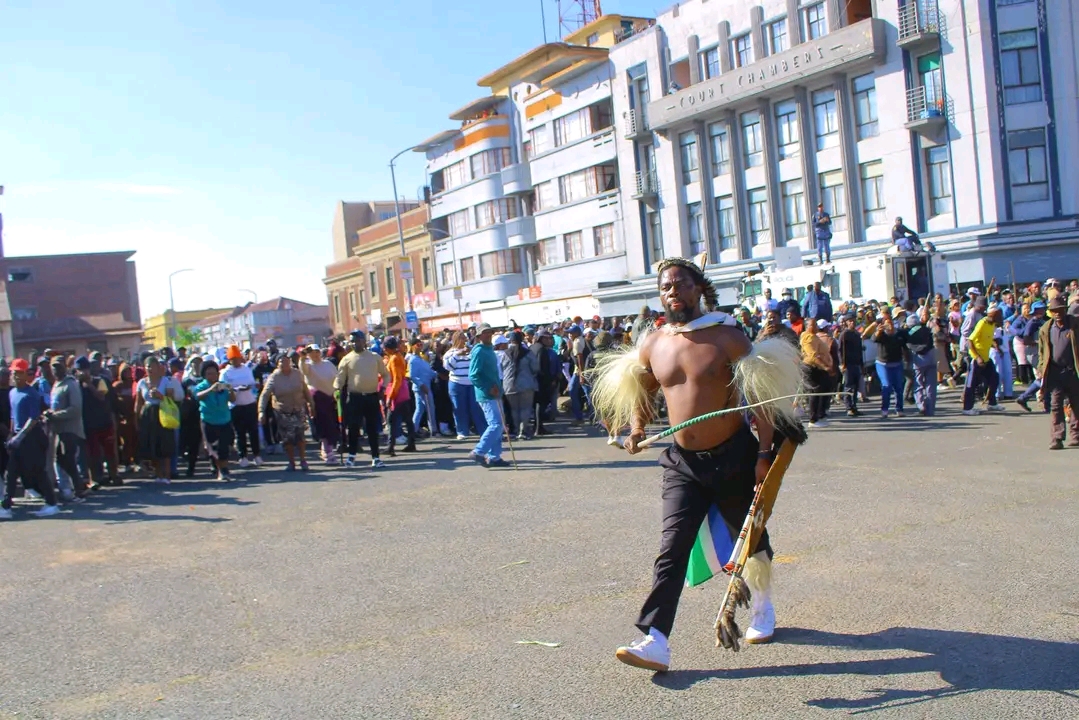
With June 30 – the D-Day where illegal foreigners have been threatened into a forced exodus or else ‘we’ll see’ – not too far off, what is one to make of 19-year-old Nhlamulo Sambo? In what is already an incendiary climate, all manner of speculation has come to the fore in the wake of the youngster’s untimely death. Police – usually tight-lipped in front of the cameras – were seemingly eager to let slip the sort of information that suggests he was a participant in a robbery gone wrong when he was allegedly chased down and stabbed to death by his assailant in Mossel Bay.
But this all comes when certain quarters – partly spurred on by a statement from Sambo’s family – have already framed him as one of the first casualties of the carnage and possible pogroms that have been suggested by the anti-immigration protesters. Others place him as a martyr murdered simply because he wasn’t South African enough. ‘South African’ in this case subjectively connoting ‘Nguni’ a label which is fast becoming widely fingered as the heartbeat of the mobilisation and dissent.
Sambo’s murder comes as videos of violence and mobs going door to door and harassing foreigners share reel space with those of the Mozambican government reportedly repatriating hundreds of its citizens. According to a news clip on DW Africa, a certain Adelmar Mambo, a Mozambican national claiming to be fleeing the violence at Mossel Bay said the mob didn’t care at all about his immigration status. That he is simply not South African was enough for them to warn him to leave. The Malawian government has sprung to the rescue of some of its nationals whilst the Nigerian Foreign Ministry spokesperson has indicated that some 1092 Nigerians have registered to voluntarily leave the country citing ‘disturbing reports’ from groups like March and March and Operation Dudula. Ghana has already repatriated some 800 of its nationals, this as certain utterances made by their foreign affairs minister, Samuel Ablakwa, jolted his local counterpart, Roland Ramola, into coming out to publicly dispel them.
Meanwhile, the predicted troubles highlighted in my previous piece have kicked in sooner than expected. Now they are bearing down hard and it seems the horse has bolted all the way to Parliament, social media and Harding, where a chilling standoff between taxi operators and a group led by the perpetually-cussing Ngizwe Mchunu recently took place. If there ever was a moment that spoke to how things could tragically spiral out of control, it was this: a taxi industry that is often synonymous with trigger-happy conduct over matters as seemingly trivial as disagreements over routes and fares coming face to face with an anti-immigration mob that is proving to grow larger and more emboldened by the day.
One fast move in such circumstances and things could open up a whole new dynamic to what is an already turbulent and uncertain impasse. Nkosikhona ‘Phakel’umthakathi’ Ndabandaba the man who is capable of mobilising the anti-imigration troopers has publicly instructed ‘arrogant’ Nigerians to leave the country. On an Eye Witness News interview he has distanced himself from a video showing people looting in KwaZulu-Natal as well as of violence even though he is shown on at least one video assaulting an unidentified man.
But the mayhem has not only been all doom and tense nerves. The urgency and pressure applied on the ground has seen the issue of immigration being strongly ventilated in Parliament, with members of the GNU sometimes voicing differing views. At a media briefing, the Special Investigating Unit disclosed findings that clearly show how deep this all goes from a report that exposes corrupt officials who occupy very high office at Home Affairs. From an internal syndicate that facilitates documents to nefarious collusionsand bribery, it opened one’s eyes that the illegal foreigner would not be so prevalent were it not for greedy suits. The SIU, has among others, also found that the Free State Office of the Premier has granted bursaries to employees, family members and seven foreign students without approval to the tune of R579 million.
It’s unsurprising, therefore, that President Cyril Ramaphosa called an unexpected family meeting this Sunday, 7 June. Although he conceded that ‘there have been weaknesses in the way that migration has been administered in our country’ Ramaphosa assured his audience that his government was nonetheless ‘taking further measures to secure our borders’. On this score, he promised investment in modern technology, infrastructure and personnel as well as a ‘phased relocation of refugee reception centres to border posts starting with Tshwane Centre this current year.’ In his list of strategies was the phasing out of the green ID; ‘increasing inspections targeting companies employing undocumented foreign nationals; increasing penalties – including imprisonment – for employers who violate the Immigration Act;’ and setting ‘up dedicated courts to deal with immigration to speedily support the deportation of undocumented migrants.’
‘I must make it clear, he continued ‘that only the authorised government officials may act against violations of the law. No other person is allowed, for example, to confront someone in the street, in the pathways of our country to demand proof of identity.’
This was the utterance that was always going to invite immediate clapback. Shortly after Ramaphosa’s address Jacinta Ngobese-Zuma went on television to question whether the president’s aides were sufficiently-informed on the actual severity of SA’s immigration problems to offer reliable counsel. She claimed that border control were working at only 25% capacity, called the president’s remedies ‘impractical’ and questioned how the state basically expects citizens to fold their arms when the laws allow for ‘citizen’s arrest?’ She stated that Ramaphosa failed to take various ‘patriotic organisations’ into his confidence by at the very least availing himself to meetwith them. The African Transformation Movement’s (ATM) Vuyo Zungula also lambasted Ramaphosa for practically gaslighting citizens into a ‘false hope’.
Although there were some pats on the back for Ramaphosa from some of his political partners, it was business as usual for people like Ndabandaba. From the videos circulating, the president’s words appear to have fallen on deaf ears as the marches, stand-offs and warnings continue to ring loud out in the streets. In fact, likely because they had reverberated effectively enough to draw the President’s attention, they seem to have been upped a notch.
Featured image: Nkosiikhona Ndabandaba leading a march. Source: Nkosiikhona Phakel’umthakathi Ndabandaba Facebook page.