
Since President Cyril Ramaphosa announced his application for an expeditious review of the indepent panel report, processes that are usually chronically glacial have started to chug on unusually fast. Even to the man praised as a master of the long game, the May 8 ConCourt judgment was such a blindside it had him coming out to publicly address a matter which hitherto had been a no-go zone at pressers. However, this particular family meeting this past Sunday took on a morbid tone: flushed, low-spirited – the last we saw him looking like that was when the country’s supply of respirators was severely strained and the bodies were piling high during Covid.
Not even Washington’s hostility towards SA could stop Ramaphosa from pulling off a resounding speech at the Global Progressive Mobilisation in Spain earlier this year. Even in front of the Farlam Commission into the Marikana Massacre, he was in his element, occasionally taking the gloves off as he squared up with the likes of Advocate Dali Mpofu. But not even the strongly-worded speech this Sunday, could conceal that there was something utterly deflated, maybe wounded about the head of state.
And ‘opportunistic elements,’ in ANC Secretary-General Fikile Mbalula’s phrasing, immediately smelled blood. Speaking at a media briefing during the ANC’s special NEC meeting on 13 May to discuss the Phala Phala issue, Mbalula suggested that the president enjoyed the full support of the party in his decision not to resign. Mbalula also seemed to be undergoing the stirrings of something akin to a Damascus moment as he, rather ironically, said:
‘What we will not do as the ANC is to be oblivious…like it happened in the past to the law itself and be corrected by the courts. You will remember…with the judgment on Nkandla, it was very clear what the Public Protector was saying we must do. We had options before us and instead we invented our own rules and we were punished by the Constitutional Court. We have learnt from experience about that so we can’t be delinquents when it comes to the law and the Constitution of the country.’
But the drawing of the laager around Ramaphosa immediately raises questions about ethics and a party that clearly hasn’t quite learnt its lesson. Whatever happened to the New Dawn rule that anyone with a cloud of wrongdoing hovering above them should be asked to ‘step aside’? Or its predecessor which expects cadres of such moral standing in their conduct that they will effortlessly pass through the ‘eye of the needle.’
Towing the party line has repeatedly proved to often place party interests over those of country. And Ramaphosa himself has been a willing participant. About four years ago, a leaked audio clip of the president allegedly telling the NEC that he would sooner ‘fall on the sword’ than to reveal the names of ANC cadres who had used state money and resources to bankroll various election campaigns around the time of the CR17 bid. Reportedly he’d said: ‘one of the officials said soon they will be revealing about how money was used for some campaigns, and I said I would rather they say you got money from this business for CR than for the public to finally hear that their public money was used to advance certain campaigns.’ Anywhere else such revelations would lead to the culprit hanging his head in shame, reconfiguring their relationship with transparency, in the ANC, however, it’s business as usual.
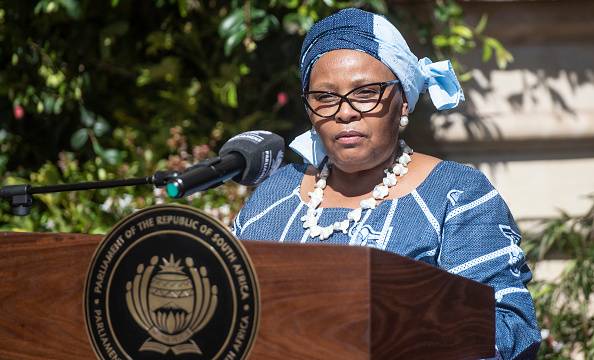
One high-profile cadre who has undergone an unexpected change of heart is former Parliamentary Speaker Nosiviwe Mapisa-Nqakula, now facing serious charges of graft. Sitting with former EFF official Dr Mbuyiseni Ndlozi on the Thabo Mbeki Foundation’s African Renaissance Podcast, she came out pontificating on how ‘we need to think beyond party line,’ a sentiment supposedly inspired by the recent devastating judgment.
She does not waste time to throw Mbalula under the bus, fingering him as the jackboot who strongarmed the ANC caucus into rejecting the indepent panel report in 2022 and whom Mapisa-Nqakula feels gave her colleagues the impression that she harboured a personal score with Ramaphosa who had removed her from Cabinet. She does, however, express concern that the report now returns to a Parliament in which the ANC no longer enjoys a majority and is generally panic-stricken. Her comments echo those of Baleka Mbete, former Speaker in the National Assembly, who came out with similar views on a recent SABC interview.
Individuals like deputy minister of water and sanitation David Mahlobo have come out to cheerfully support the president, so has the ANC Youth League. The one organisation that has not bought into the cheerleading has been the SA Communist Party. Solly Mapaila, the General Secretary has been raining fire and brimstone openly calling for Ramaphosa’s immediate impeachment.
Meanwhile, Mbalula could have gotten away with painting a picture of a tightly united front were it not for some suspicious chinks. Nkosazana Dlamini-Zuma, Parliamentary Speaker Thoko Didiza and Thabo Mbeki are reported to have snubbed the NEC gathering. Nonetheless, Mbalula and Company are still sitting pretty given that the impeachment is highly unlikely as it will require a hefty two-thirds majority vote to pass. As I write, Didiza has outlined the process of putting together a 31-member impeachment committee by 22 May.
But what has preoccupied much of the discourse is in which way will GNU parties – once bearing down hard on Ramaphosa on Phala Phala – like the DA and UDM cast their votes. Furthermore, with alleged threats of dismissal if members fail to follow the party line, would a secret ballot not be in the interest of justice? For a man who is by most accounts a constitutionalist, having helped draft the document, why has Ramaphosa repeatedly failed to, at the very least, take the nation into his confidence from the get-go?
In the court of public opinion, the running to the courts has created the impression of a man desperate to douse the fires. It doesn’t inspire confidence. Instead, it makes it look like he is using the loopholes and graces of the nation’s supreme law to avoid having to honour some of the Constitution’s base tenets namely transparency and accountability to the very people whom that founding document was meant to serve.
Featured image: Former Parliamentary Speaker Nosiviwe Mapisa-Nqakula. Source: Government Online.