
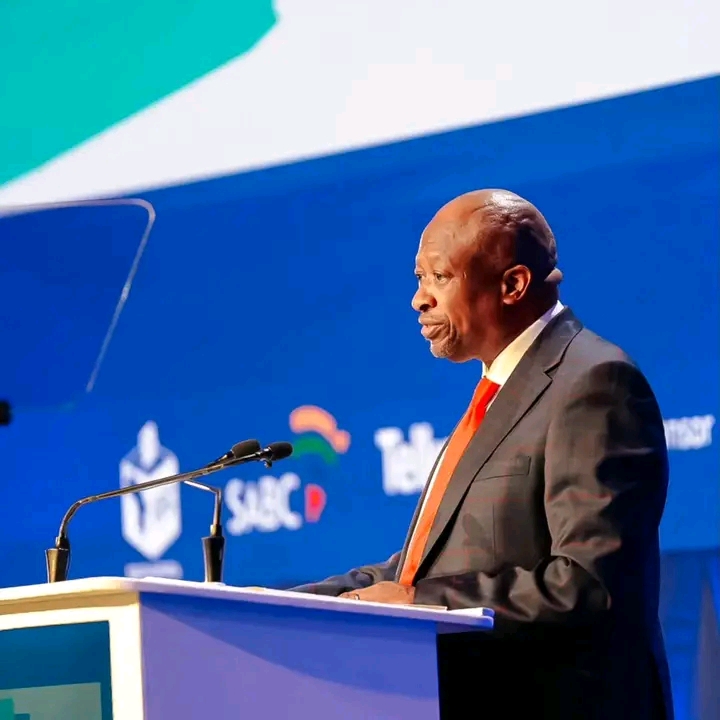
With the ANC suffering their worst election ‘wipeout’ of the post-democratic age, the upset has been writ large on the faces and posture of cadres who were closely eyeing the numbers on the screens at the National Results Operations Centre (ROC) in Midrand, Johannesburg. From the time the initial figures began filtering through, it wasn’t looking too good for the usually unperturbed, cossetted African National Congress.
From the get-go they found themselves batting on the backfoot, blocking and fobbing off pesky questions from journalists in an effort that soon began to sound like a desperate self-defence exercise. It was easy to tell that this election would not have the usually favourable patterns, therefore it was quite understandable that the cadres might be sullen and disinterested, a far cry from the braggadocia of better years. Things had never been quite like this, and I suppose falling on hard times will leave even the most fiery Marxist aficionado looking flushed and a little like they just want to go home.
The ANC’s first experience with an obscene hammering came inside the same venue a little over two years ago and back then it seemed that it was all a bad dream. Now, the numbers are telling us that the losses and bloodbaths are a nightmare that may well be here to stay and it’s clearly giving the big guns sleepless nights.
Example: Gwede Mantashe’s incredulous response to the question ‘what’s ANC doing that is losing the metros and the urban vote?’ Who was this Mantashe? Certainly not the cardsharp who’s been chewing up and spitting out opposition rivals at the ROC for nearly two decades.
‘Elections,’ he pontificated ‘must never be about metros. I grew up in Cala, it’s not a metro. It’s a nine wards municipality. I love it. Every ward there is controlled by the ANC. I grew up in Chris Hani District, every municipality there is controlled by the ANC and I think that is important. We don’t pay attention to rural municipalities which is … it is actually my passion. I normally campaign in rural areas. I enjoy it because it gives you results. People there are genuine; what you see is what you get. In the cities you must do more when you do, they want more, you give them a house, they say ‘but there’s no electricity, we won’t vote for you.’ You give them electricity [they say] ‘water is no consistent.’ They don’t vote for you.
The italicized part in particular was all the confirmation that the online pundits needed to conclude that, ‘ja, now we get why the people voted in the way they did.’ In one short paragraph, Mantashe was basically telling urban dwellers that their expectations of affordable housing, running water and reliable electricity were too steep. And, the fact that their loyalties were not to any party except the one that could deliver on its promises. Mantashe was saying that rural folk had gotten so accustomed to substandard services that they were happy with whatever little they got. The word started flying around: ‘tone-deaf.’
Anyway, as if City of Johannesburg mayoral candidate Helen Zille’s cheerful mood wasn’t smug enough, the party’s alliance partner, the SACP which had resolved to contest elections independently in 2024 just had to rub salt in the ANC’s wounds. ‘There is no automatic support for any single party,’ said SACP Secretary General Solly Mapaila when asked if his party would be entering into a coalition with the ANC.
After three days of counting, the numbers were officially released on Sunday evening. At 30.76% and securing 3 246 council seats, the ANC bagged the biggest share of the vote, with the DA getting 24.64% and 1 695 seats. With 9.76% and 785 seats MKP came in at third place followed by the EFF at 6.22% and 588 seats and ActionSA at 5.67% and 313 council seats. A collective 22.9% of the vote went to independent candidates across the country.
Although it is the leading party in 128 municipalities, the ANC only managed to gain outright control in only 53 of them. In just five years, the party has descended from 45.59% to its present figures, a decline of almost fifteen percentage points. The DA has gone up by 2.98%, the EFF has dropped by 4.09% whilst ActionSA is up by 3.34% and, at their maiden showing at local government level, MKP (9.77%) have pulled off an impressive performance.
In the metros, the DA has kept up the momentum, securing the highest votes in five of them (City of Johannesburg, Tshwane, Ekurhuleni, City of Cape Town and Nelson Mandela Bay). The ANC took the Buffalo City and despite earlier numbers suggesting that the DA might take Mangaung metro as well, the ANC ultimately prevailed by a tiny margin but lost out on eThekwini to the MKP.
With several hung councils across various metros and municipalities, it is clear that coalitions will decide the way forward in this new political environment. Negotiations are already taking place in Nelson Mandela Bay, with the DA reportedly having reached out to the FF+, ActionSA and UDM. Although ActionSA is considered the kingmaker party in both Johannesburg and Tshwane, party leader Herman Mashaba has expressed misgivings if such talks include Zille.
Meanwhile, Julius Malema has also been making utterances around the ‘lost children’ of the ANC, namely his EFF, the SACP and MKP burying the hatchet with the ANC. But the suggestion also comes with his own fiery demand: Ramaphosa should not be part of it. As far as difficult negotiations go, eThekwini and Mangaung may prove to be the toughest. The relations here are steeped not only in ideological differences between parties but also in personal history.
With exception to several incidents doing the rounds on social media, the only revote announced by the IEC will be in Douglas, Northern Cape. Declared ‘free and fair,’ the election process went relatively smoothly. Now the country can only hope that that momentum will hold during the process of cobbling up strong and service-driven councils.
Image: Chief Electoral Officer Sy Mamabolo announcing the results of the 2026 local government elections. Source: Electoral Commission of South Africa Facebook page.