
Revisiting the nation’s amble towards democracy from the perspective of Colesberg and other rural areas arouses interesting stories from people of otherwise simple backgrounds. Frontline activists recall a monumental task that history had cut out for them. At the outset, it was education-driven. Brief, off-the-cuff, a night-school-like crusade with little time to assess if the masses, many of whom were without formal schooling – apolitical, menial labourers so long disenfranchised they would’ve been unaware of the power that had just been thrust upon them. Some would’ve guffawed in the face of anyone who told them that an ‘X’ (ironically the same symbol many would’ve used to sign their name) made in the correct box on a piece of paper could potentially improve their station in life.
For the transition-era cadres, it was impulsive: you met a man and simply told him to vote for Mandela whose name was slowly becoming synonymous with the promise of change, piped water, a new house and no longer having to take orders from the baas. Effectively, it was an upending of ingrained deference, unlearning the racialization of servitude, and was far from being an easy task. Black homes had mostly only just recently been introduced to the grid and television sets were still a novelty. Radio remained hands-down the most popular form of media but it didn’t show you people’s faces. Newspapers were considered aloof interests for educated sorts and mostly useful when the windows needed shining.
Mandela had only recently been let out of prison and many had no idea what the man who would be president even looked like. Factor into this threats from old-establishment employers of reprisals if the black workers dared to vote for the ‘terroris’ and there was a point to be made for the vigorous street politicization. Those who cut their teeth in black settlements during this time – the forging of the Madiba myth – will ramble ad nauseum on how this changed everything, right down to the decor inside the home.
The ubiquitous posters of Mpho and Mphonyane Mathibela – the adored siamese twins born in 1986 at Baragwanath Hospital had always held pride of place on the cinderblock walls within township homes. So did cheap copies of da Vinci’s Last Supper nailed alongside framed Biblical lamentations, or a bloodied Christ crucified on the cross. Now, with the unbanning of political action, merchants were struggling to keep up with demands for portraits of the fist-raising Nelson Mandela. For the first time political affiliation was no longer a hushed matter but part of the domestic fabric, freely mingling between discussions on the ancestors, God and family.
On radio and television, Sello ‘Chicco’ Twala’s singalong ‘Peace in our Land’ coupled with the white t-shirts with the doves emblazoned on the front were a piece of calming proselytizing amid the uncertainty. The message was clear: ‘throw your pangas into the sea’ and ‘wat verby is verby’. Whatever desires of retribution or getting even with the former enemy had no place in this new democracy. The way to a better future was to simply let bygones be bygones.
27 April 1994 would see the crescendo of all these efforts, many untold bloody and painful decades in the making. Although there may have been lingering fears of violence, the images that spring to mind, or the ones that have really stuck, are the archived aerial shots of the long, snaking queues. They seem to stretch on forever, signifying a long-held dream by so many. Rows upon rows of people, young and old, wheelchair-bound, smiles and waving hands, some swathed in heavy clothing to keep the beckoning winter at bay all turning up to have their say in the country’s re-shaping.
Voting for the first time, this was a very personal history and a standalone privilege for those who were now actively participating in their own emancipation. The mood was hopeful, euphoric, brimming with promise and possibility.
Thirty-two years to the day, at Bloemfontein’s Dr Rantlai Molemela Stadium, the images told a different story. The televised images, in this case being noticeably kind on President Cyril Ramaphosa as he stood up to address what appeared to be a pitifully low turnout. Although the marquee from where the President addressed dignitaries seemed full, circulated images showed practically empty stands.
There were no delirious flag-waving revelers. No jubilant crowd to sing along to the entertainment lineup. In fact, the news-grabbing highlight of the day was when an overly-excited fan tried to rush the stage. And, of course, social media was quick to make a meal of the embarrassment with the ANC’s usually prolific Facebook page (MyANC) seemingly not posting any photos from the event.
One could wrack one’s brain pondering as to why residents of Bloemfontein – once a sturdy stronghold and the ANC’s founding city – sought to sit the president’s visit out. Or why, unlike the eager generation of 1994 who looked hopefully towards the new dawn, people are nowadays openly apathetic and no longer have the appetite to pretend otherwise. Yet to go down that road would probably mean getting all bogged down on the same old tired complaints.
What is pretty clear, however, is that the circumstances have so drastically changed as to frequently leave one gobsmacked. In just thirty short years whatever enthusiasm that had kept the ball rolling and the people faithful is dwindling. The snaking queues are no longer. The euphoria is a figment of one’s imagination. Not even the promise of a meal is enough to get even the poor to come out. One must wonder what this tells us about what the people were promised versus what they’ve actually been getting for the past three decades.
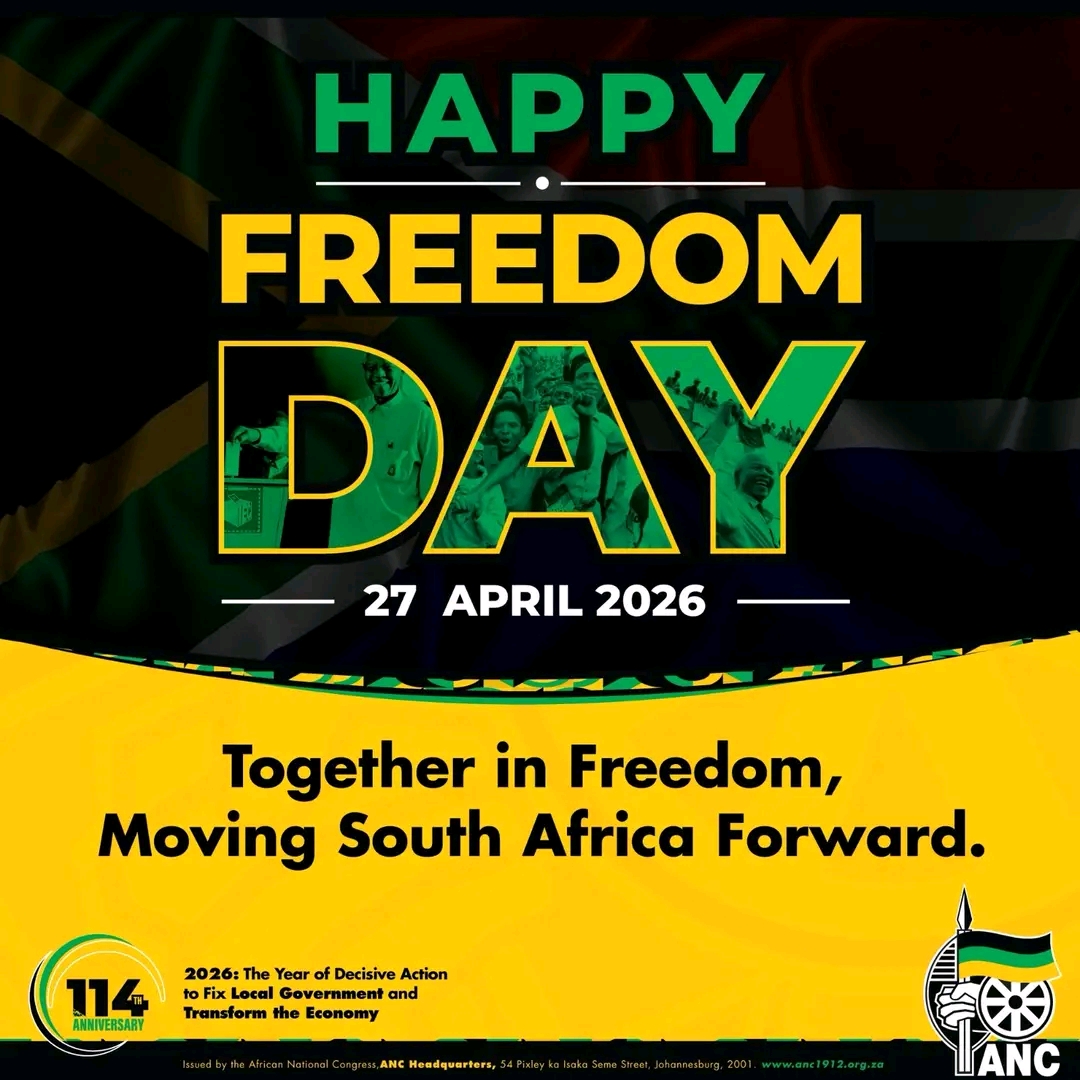
Featured Image: An ANC promo on Freedom Day. Source: MyANC Facebook page.