
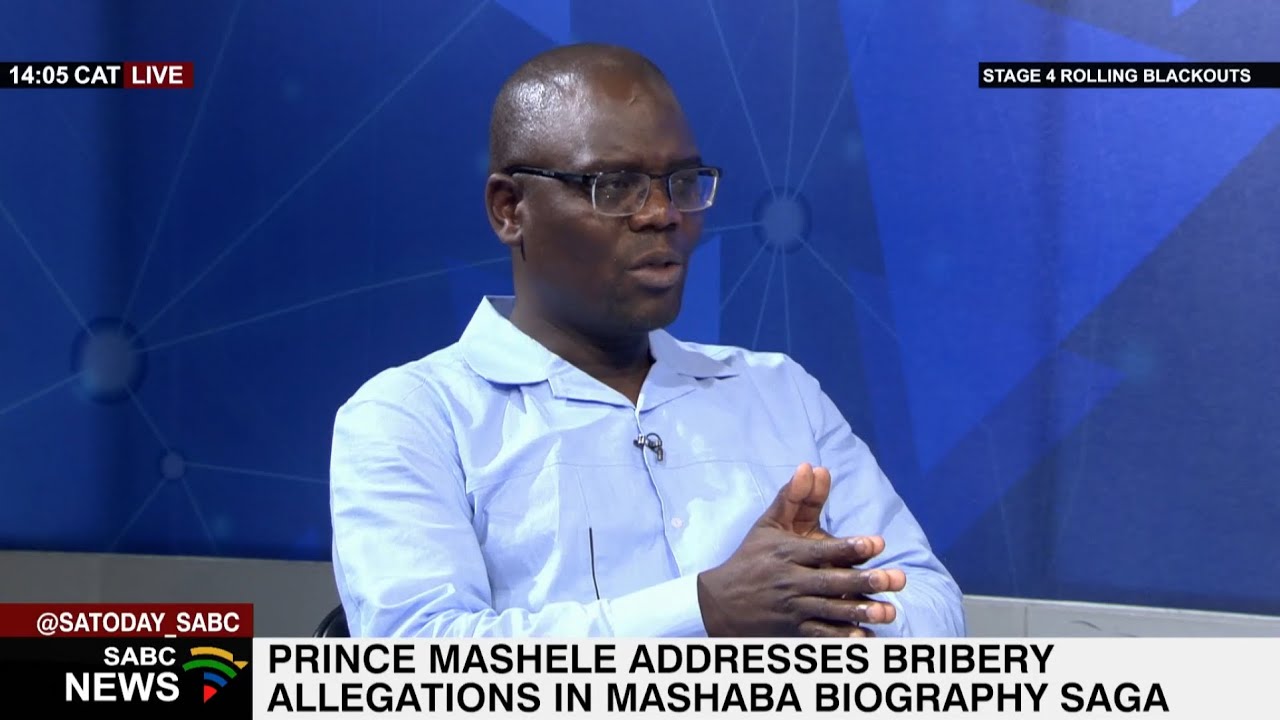
Amongst disillusioned black folk Prince Mashele was once a literary Doctor Khumalo whom many were always eager to get behind, this whilst he was a thorn in the proverbial behind for the ruling elite. His column on The Sowetan newspaper was a surgical, scathing read churning out tongue in cheek insights rich with insults every week. In his estimation the EFF, for instance, could never be trusted because they were ‘graduates of the corrupt ANC.’ He rubbished big political figures as ‘expired dinosaurs,’ one was ‘a hollow tin,’ and those were rather kinder in the vastly colorful language in his arsenal.
Mashele’s searing pen, aflush with wit and sarcasm could burn the most high-profile figures seemingly without a moment’s thought. A streetsmart scribe and a savvy political scientist, it was he that media houses often turned to for exciting, provocative political analysis that kept the eyes tuning in. He was practically furniture on televised debating shows, often stealing the limelight and almost always leaving his adversaries biting the dust. His analysis recognised no sacred cows and anybody who thought they were untouchable, would soon find himself dragged through the mud by a man who seemingly had the rare quality of incorruptibility. There is the iconic exchange between Mashele and BLF’s Andile Mngxitama, an intimidating voice in leftist circles, where the former had Mngxitama eating humble pie on the land question.
This was perhaps Mashele’s most distinguishing super power, how his character appeared faithful to the words he spoke in front of the cameras and the ones that his loyal readers cut out from the papers. An honest, independent mind – indeed an oddity in the shady terrain of analysts often beholden to corporate magnates and big money. In fact, he was amongst those proto ‘clever blacks’ who came out against the ANC at a time where such dissent often meant one’s employment opportunities might be stifled. So it is against this backdrop that his comeback particularly in the alternative media arena has been met with mixed reactions.
His recent sojourn on to The Truth Report, a podcast hosted by controversial billionaire Rob Hersov has the rumour mill grinding out all sorts of speculation and conspiracy theories. Could the voice that once spoke out so vociferously against cadre deployment, government ineptitude and corruption be in the pocket of slippery businessmen? Was it all just an act and is Mashele finally unraveling before us all? It doesn’t help that despite his criticism of the ANC back in the day, he was reported to have applied to be a public representative of the DA in the lead up to the 2019 elections. Then there was the scandalous story on Mashele’s ‘unauthorised’ book on Herman Mashaba which later turned out had actually been funded to the tune of R12.5million by the ActionSA leader.
Perhaps preempting the lingering scrutiny and skepticism, Mashele commences his interview with something of a veiled disclaimer: ‘The idea that someone is going to tell me what to do, when, makes me extremely uncomfortable. So, I want to be truly free to do what I want to do … that is the essence of my being.
He goes on: ‘Whenever I get a platform like this to say something, it drives some people mad … I actually don’t car. If you don’t like what I say, hard luck.’ From there, the viewer is taken on a rundown through SA’s historic journey according Mashele. From the British who first ran the empire primarily through mining, to the Afrikaners who added parastals then the Democratic-era black government who ‘plundered the infrastructure that was created by both the English and the Afrikaners.’ This, he points out, was the beginning of the decline.
‘When the blacks took over, the hope was they were going to use state power to develop themselves as a group. They did not. What did they do? They actually… and this is the original sin that was committed by … the ANC. Instead of asking themselves ‘what component can we add to the economy’ … they said ‘how can we get into the white man’s tent?’
So, he calmly concludes, the blacks did not add anything to the economy other than to plead for a seat at the table, a move that was welcomed by whites who were more than happy to indulge a few black elite ‘because that meant that the blacks would not actually rise and become a formidable group.’ Hence today, he says we have the likes of President Cyril Ramaphosa and Patrice Motsepe, co-opted individuals in a setup where the black population are merely consumers rather than creators of wealth.
Asked whether the needle might turn and usher in a generation of young black entrepreneurs, Mashele says, yes, but that would require a ‘black Renaissance.’ But, that would be painful and ‘black people are not prepared to take pain.’ This pain would further require an acknowledgement that ‘as a collective they are backward, they are underdeveloped.’ For non-white societies, the turning point first came where the Japanese proudly elevated themselves to the level of whites, says Mashele. This was achieved through an ‘intellectual revolution’ led by ‘a visionary elite.’
The key thing that the Japanese found set white society apart from them was education, specially ‘technical education – maths and science.’ This should be a national priority along with pulling ‘a Margaret Thatcher on SADTU … clear them out of the way so that you don’t gamble with the future of black children. If you do what I’m telling you, over time, a period of twenty to thirty years, black people will be ahead of many other groups in the world.’
In SA, he points out, the best performing learners in maths and science are Indians, a minority that ‘don’t worry about some nonsensical ideological stuff that people debate on a daily basis … they study.’ This lifts them above the rest. ‘Black people,’ on the other hand, ‘are busy talking about uMkhonto WeSizwe, a backward force’ that sings about the land. Yet, they don’t really know where true value is. In America, Mashele persists, majority of landowners are white yet the wealthiest people there are Asians.
By 2029, the ANC will be irrelevant, he says, a decline that began around 2007/8 when the party began to fall ‘in the minds of people.’ That’s when people began ‘talking about the ANC in a disrespectful manner. Come 2029, the party will be very lucky if it gets fifteen percent of the vote.’
In light of the peonslaught from the US against SA, these are some of the voices that have been creeping out of the internet. Although many of them read from their orthodox liturgy, Mashele, as usual attracted the larger share of the spotlight. That he seemed to have been rehashing Hersov’s similar talking points, aroused the obvious questions. When mainstream media seemed to have mostly cast him away, why is the billionaire so keen to have him on? Has Mashele been reduced to a paid mouthpiece doing the bidding of capital interests? Has – in Hersov – Mashele found someone else to bankroll him or is he still the same pundit who bulldozed his ideas through, no matter who was in the way? The country is left to speculate and Mashele must be basking in the comeback.
Featured image: Prince Mashele on an SABC interview. Source: SABC YouTube channel.