
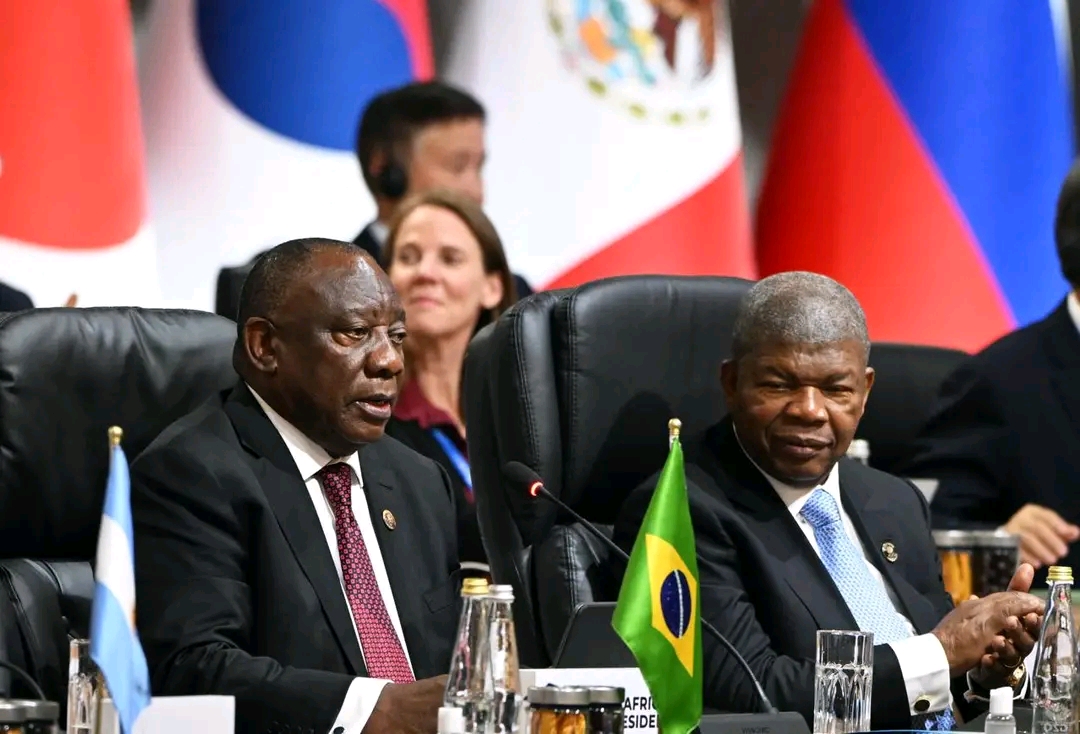
As Washington sought to throw another spanner in the works by not just boycotting, but openly mocking the G20 summit, the famously ‘wimpish’ President Cyril Ramaphosa had quite clearly had enough. At a press conference a few days before the meeting, he cast aside the measured monologues for something that suggested he wouldn’t be taking the assault lying down, leaving no doubt in anyone’s mind that America – to paraphrase Minister of International Relations and Cooperation Ronald Lamola – would simply be ‘marked absent’ and things would go on without them.
Both Ramaphosa, Lamola and the broader GNU would’ve clearly reached consensus: earlier efforts in May to appease Trump had fallen on the sensibilities of a man whose personal gripes override all facts or persuasion, and so perhaps it was time to take the gloves off and unleash the Buffalo. Give The Donald a taste of the medicine he is said to be particularly intolerable of: not being given special treatment. Presidential spokesperson Vincent Magwenya was amongst the first to speak out openly. ‘America’ he said, ‘chose to boycott the summit. That’s their choice, and that’s their prerogative to do so.’ But then, why spoil things for the nearly 40 countries who’d turned up for the first G20 ever hosted on African soil?
It all caught one completely unawares that the ‘sellout’ who’s often derided as doing the bidding of capitalist interests would be praised by a plethora of social media posts and at least one of them saying he was charging ‘a stunning display of continental assertiveness’ by delivering a ‘fiery response to United States criticism over his country’s expanded G20 guest list.’ Even Reuters was quick to note that this ‘bold tone was a striking contrast to his subdued decorum during his visit to the White House.’
Said Ramaphosa later: ‘It cannot be that a country’s geographical location or income level or army determines who has a voice and who is spoken down to. And it basically means that there should be no bullying of one nation by another nation. We are all equal.’
This united front held. So much so that the generally disapproving comments on the socials were tilting between some dislike but (surprisingly) a great deal of support for ‘Cupcake’:
@Gerson:Why do I feel like this the well seasoned president South Africa can ever have (sic)?
Another: @Gabhisa:Cup Cake has shown great diplomacy but firm leadership as G20 President and I[n]ternational leadership. Well done Mr President.
How about this one: @Lucky Njube:What can Argentina offer the world except for Messi, They are here as Donald Trump agent[s].
The last one comes on the back of Argentina’s rejection of the G20 declaration, which, breaking away from tradition was adopted at the beginning, rather than at the end of the summit.
Of course, Donald Trump’s apparently unilateral knee-jerk decision to boycott the multi-national appointment had obviously gravely offended Pretoria, which was set on making a favourable account of itself especially against the backdrop of the much-publicised SA-US squabbles. Trump’s dictatorial posts and comments were intended to achieve similar ends. And, for a while, here and abroad, they appeared to do just that.
Right-wing media lapped it all up, anti-ANC personalities had a field day, even omnipresent hasbara cogs finally had something to distract from the hostile perception of the happenings in Gaza. Crawling out of the woodwork here at home were the usual suspects, the likes of the State of the Nation, a social media channel hosted by Mike Sham. Sham, who’s also furniture on BizNews ruffled feathers with this nugget: ‘I’m taking it as a big win. I hope that more presidents pull out of this G20 … I’d be delighted to see this thing as an abject failure and for South Africa to get kicked out of the G20 so that we can earn our place when we get back in.’
This sorority, comprised of apparently gleeful race-baiters and at least one angry billionaire were thrilled that the world was finally paying attention to ANC stuff-ups. But when Trump overextended his hand by pressuring SA that no resolution should be decided on in the absence of America, he’d practically taken a matchstick to the powder keg. From there, the government spoke with one voice, driving the point home that in SA, the buck stops with Ramaphosa, not Potus.
But then things got slightly confusing during the week when the SABC broke the news – and Ramaphosa confirmed – that the US were undergoing a change of heart and did in fact wish to participate. But the US Press Secretary Karoline Leavitt cheekily poured water on this, saying the president was simply ‘running his mouth’ and that the ‘United States is not officially participating in official talks at the G20 in South Africa’ adding that ‘that language is not appreciated by the president or his team.’ She further clarified that the ‘representative of the Embassy in South Africa is simply there to recognize that the United States will be the host of the G20. They are receiving that send-off at the end of the event. They are not there to participate in official talks despite what the South African government is falsely claiming.’
But it was her own language that saw South Africans, wielding the sort of vocabulary best left to booze-addled tavern disputes, flooding clips of that video. Some brightspark muso even penned a heartfelt pop song only relying on the comments as lyrics. (Here we must insist that this may not be the sort of material for sensitive listeners).
But it was the move to send the aforementioned representative, a charge d’affaires, that prompted Lamola to fight fire with fire. Sternly, he said: ‘We did not deny anyone access. The United States is a member of the G20. If they want to be represented, they can send someone at the appropriate level. This is a leaders’ summit.’
And because the world’s attention was glued on the events taking place at Nasrec, Johannesburg, the moment was ripe for other elements to share in the spotlight. In no time, MK Party and Operation Dudula amongst others, found themselves clashing with police after they’d staged a protest demanding to speak to Ramaphosa and world leaders. Ultimately, there were clashes, teargas canisters fired, some manhandling, and arrests made. It was chaos, to be sure, but nowhere quite as chaotic and uncertain as what may come from the strained relations between the country and the US. What is, however, pretty clear is that if Donald Trump sought to publicly embarrass SA as he so often does with his underlings and reporters, he may find that not only is the joke on him but actually his blunders were a rare occasion to have (most) South Africans actually agreeing on something. No doubt that’ll all be gone by Sunday morning, but it sure felt good while it lasted.